
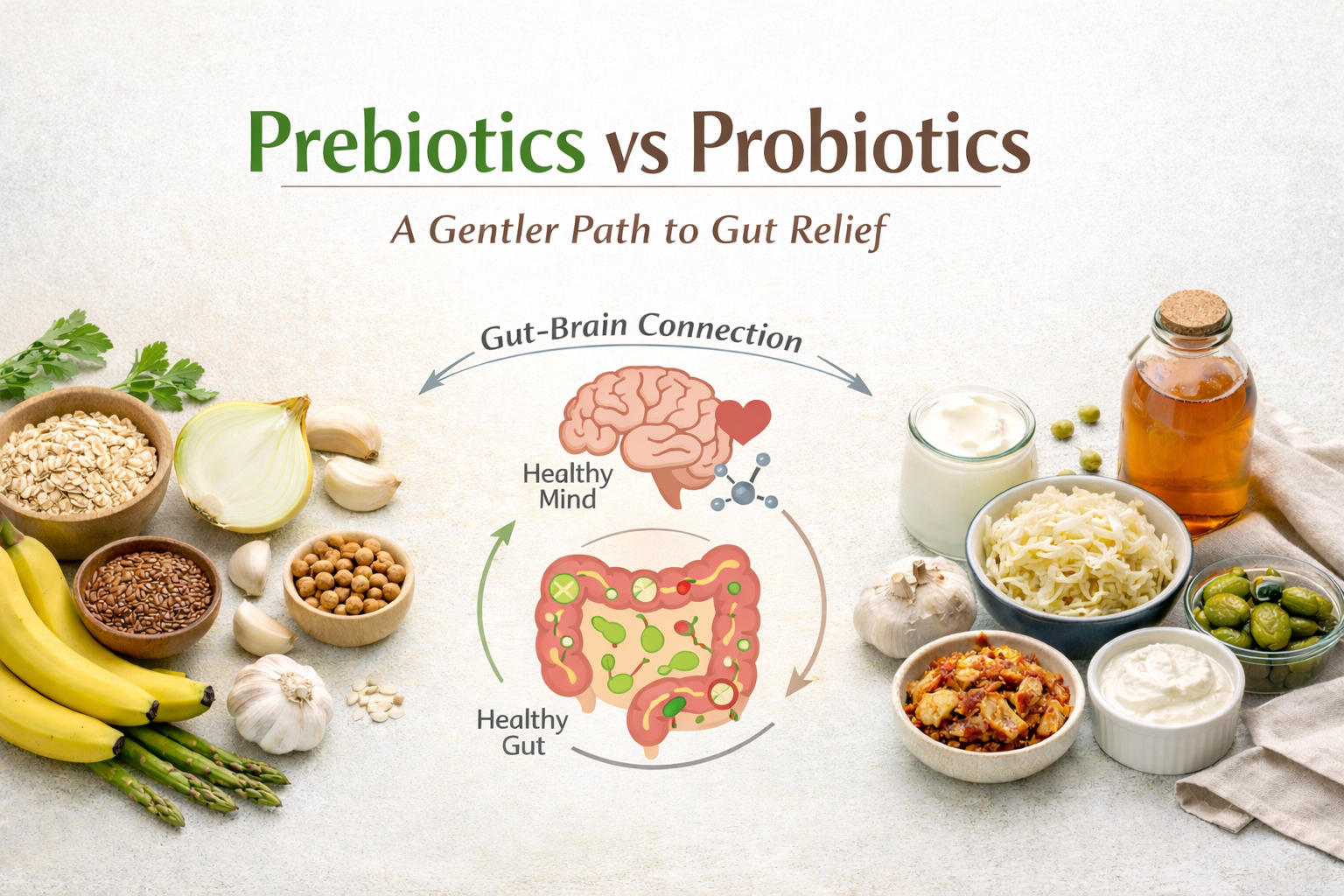
If you’ve ever noticed that gut symptoms and mood symptoms show up together, you’re not imagining it.
Bloating, irregular digestion, low energy, anxiety, low mood—these often travel as a group. And for many people, the missing piece isn’t another restriction or another supplement, but understanding how to support the gut in a way that creates relief instead of more stress.
That’s where the conversation around prebiotics vs probiotics becomes useful—not as a trend, but as a tool.
Let’s break it down simply, calmly, and practically.
Prebiotics vs Probiotics: What’s the Difference?
When people hear “gut health,” supplements often get all the attention. But your gut doesn’t just need more bacteria—it needs the right environment to function well.
Your gut microbiome (the foundation)
Inside your digestive tract lives a complex ecosystem of trillions of microorganisms—mostly bacteria—that help:
Digest food
Absorb nutrients
Regulate inflammation
Communicate with your brain
This ecosystem is called the microbiome, and it’s highly influenced by what (and how) you eat.
Probiotics: adding helpful microbes
Probiotics are live microorganisms that can provide health benefits when consumed. You’ll find them in:
Yogurt with live cultures
Kefir
Sauerkraut
Kimchi
Kombucha
They can be helpful—but they’re not a universal fix, especially if digestion is already irritated.
Prebiotics: feeding what’s already there
Prebiotics are specific types of fiber that feed your existing gut bacteria.
Think of them as fertilizer, not seeds.
They’re found naturally in foods like:
Oats
Onions and leeks
Bananas
Beans and lentils
Sweet potatoes
For many people struggling with gut symptoms, prebiotics are the missing piece—and often more effective (and gentler) than jumping straight to supplements.
Why This Matters for Mood, Stress, and Emotional Relief
Your gut and brain are in constant communication through what’s called the gut-brain axis.
This connection helps explain why digestive distress often shows up alongside:
Anxiety
Low mood
Brain fog
Poor sleep
Here’s why:
About 90% of serotonin (a key mood-regulating neurotransmitter) is produced in the gut
Gut bacteria influence inflammation, which directly impacts mental health
Certain probiotic strains—sometimes called psychobiotics—have been linked to improved mood and reduced depressive symptoms
Research continues to show that supporting gut health can support emotional regulation, especially when done through food-first strategies rather than aggressive supplementation.
Gut Relief Starts with the Right Kind of Support
If you’re dealing with bloating, constipation, diarrhea, or unpredictable digestion, more isn’t always better.
A balanced microbiome helps by:
Producing short-chain fatty acids that support gut lining integrity
Reducing gut inflammation
Supporting regular bowel movements
Improving mineral absorption
But pushing probiotics too quickly—without feeding the gut properly—can backfire.
This is where prebiotics vs probiotics becomes less about “which is better” and more about what your body needs right now.
How to Support Your Gut (Without Overdoing It)
Start with food first
For most people, relief begins with consistent, gentle intake of fiber-rich foods, not restriction.
Helpful starting points:
Oatmeal or overnight oats
Roasted root vegetables
Beans or lentils in small portions
Fruit paired with protein or fat
Slow and steady matters here.
Add probiotic foods thoughtfully
Fermented foods can be supportive—but more is not better.
If digestion is sensitive:
Start with small amounts
Choose refrigerated products with live cultures
Avoid stacking multiple fermented foods at once
Supplements are not one-size-fits-all
Probiotic and prebiotic supplements can be useful—but strain selection, dose, and timing matter.
Poorly matched supplements can:
Increase bloating
Worsen gas
Add frustration instead of relief
This is why personalized guidance matters.
The Bottom Line: Relief Comes from Support, Not Pressure
Gut health isn’t about perfection.
It’s about creating conditions where your body feels safe enough to function well.
For many people, that means:
Feeding the microbiome consistently
Reducing digestive stress
Supporting—not forcing—change
If you’re tired of guessing, reacting, or cycling through supplements without results, you don’t need more rules.
You need a relief-focused strategy.
Want Personalized Gut Support?
If gut symptoms, food reactions, or mood changes are interfering with your day-to-day life, I help clients identify what their gut actually needs—without extremes.
👉 Book a nutrition session to create a personalized plan that supports digestion, energy, and emotional well-being—calmly and sustainably.
If gut symptoms are driving food anxiety, fatigue, or mood changes, guessing can make it worse.
👉 Browse Symptom Relief Tools
Targeted nutrition support for bloating, food sensitivities, migraines, and digestive discomfort—built around relief, not restriction.